

Close to the runways of New York's JFK airport, Paul Belz discovers a rich and diverse wildlife habitat in the heart of an urban environment
Swallows switched directions over Jamaica Bay, passing over junipers, dogwoods, and wild roses. The “Conk-a-REEEEE!” of red winged blackbirds, the “cheerio, cheerio, cheeriup!” of robins and other tunes I couldn't identify made the paths a labyrinth of birdsong.
Canada geese hissed at my partner Kate and me, warning us to keep away from their babies. An eastern swallowtail butterfly drifted past trumpet-shaped honeysuckle flowers whose color matched its yellow wings. Apartment buildings surrounded this wetland, while Lower Manhattan's distant towers seemed ethereal in the haze.
Kate and I had come here for a respite from a long layover between flights at New York's JFK International Airport. Jamaica Bay lies between Brooklyn and Queens, and is the United States' only national wildlife refuge that guests can reach by subway.
We wandered through a neighborhood whose creative citizens decorated their fences with stuffed animals and fish-shaped mailboxes, and ate at a neighborhood grocery's abundant salad bar near the refuge. This adventure was far more fun than a long sit in plastic chairs!
Lisa Sheppke is Restoration Projects Coordinator for the Northeast Chapter of the American Littoral Society, a group that protects ocean environments and wildlife, and empowers the public to join in this work.
She said: “When people think about New York City, a rich and diverse wildlife habitat is not usually what comes to mind. However, NYC is home to Jamaica Bay, a unique intact estuarine ecosystem consisting of 25,000 acres of salt marshes, intertidal flats and upland forests. The Jamaica Bay Wildlife Refuge is one of the most important bird sanctuaries in the northeastern United States.”
Jamaica Bay lies on the Atlantic Flyway, a major migratory route for birds. More than 330 species have been sighted here in the past 25 years. These include roseate terns, peregrine falcons, least terns, and other threatened or endangered birds. 70 species of butterflies also visit along with many fish and other marine creatures, such as the threatened loggerhead sea turtle.
Challenges
Lisa mentioned some of the challenges faced by Jamaica Bay. “The Bay lies at the confluence of two of the world's most urban, heavily trafficked, and stressed waterways – the New York Bight and New York Bay.”
Commercial, residential, and industrial development surrounds the Refuge. 250 million gallons of waste water from four sewage treatment plants flow here daily, along with water from sewage overflow, and run-off from roads and JFK Airport's runways.
High nitrogen contents in this water lead to algae blooms. When these organisms die and decay, the process absorbs oxygen from the water, endangering fish and
other creatures that breathe through gills.
However, the Littoral Society and other local groups are working hard to protect Jamaica Bay.
People have historically seen salt marshes and other wetlands as wastelands, only useful as trash dumps. Yet many now realize that these places can offer a range of ecological services, including wildlife habitat, and a natural filtering system that removes pollution from water.
Lisa relayed the disturbing fact that the tidal salt marshes of Jamaica Bay are disappearing at an alarming rate –some estimate as many as 40 acres per year. Scientists have not concluded whether pollution or other factors are the main cause of this problem.
Lisa said: “The Littoral Society's advocacy has helped to secure important protections for New York City's wetlands. In 2010, we joined with the Natural Resources Defense Council in a lawsuit to upgrade the bay's four sewage treatment plants. As a result, the NYC Department of Environmental Protection agreed to spend $120 million for upgrades, plus an additional $15 million for marsh restoration over the next 10 years.”
Community-led restoration
The Littoral Society's Marsh Restoration Initiative established in 2011, is the first ever community-led restoration project in a national park. More than 500 New Yorkers have helped to rebuild Rulers Bar and Black Wall Marshes, and to plant wetland vegetation.
“Neighbors donated their docks for storage of supplies, local Broad Channel boat captains volunteered their boats to ferry volunteers to the marsh islands, and many groups ranging from Boy Scout troops to local surfers have pitched in,” Lisa commented.
Restoration work includes removal of abandoned docks, damaged boats, and other debris.
“Since 1986, the Society has organized the New York State Beach Cleanup which has been responsible for removing hundreds of thousands of pounds of debris from New York's wetlands, including Jamaica Bay,” Lisa said.
Volunteers document the trash they discover, and report their findings to scientists who use them to make recommendations for combating debris pollution.
Kate and I hiked to the freshwater ponds on trails surrounded by dogwood and honeysuckle.
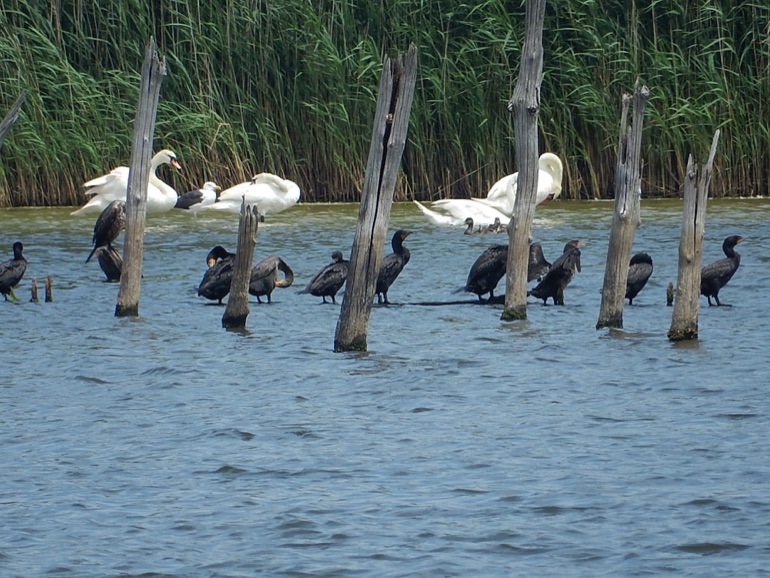
Cedar waxwings – tan birds with cowlicks of feathers – perched in other shrubs and feasted on red berries. Swans swam in one pond, accompanied by wading egrets. Cormorants swam and dove to catch fish; others perched on rocks and spread their wide, black wings to let them dry. Black crowned night herons – medium-sized grey, white, and black birds – perched on branches and slumped forward like French existentialists in a café. Dragonflies zipped everywhere; one blue pair mated in midair.
Many birds used East and West Ponds as habitat until Hurricane Sandy breached both, connecting them to Jamaica Bay. East Pond's boundaries have been repaired, and the National Park Service is working on a plan to repair the breach and allow freshwater to flow back into West Pond. They may construct a well to replace the pond's lost freshwater, and might also use municipal water or allow rainwater to refill the pond.
Both wildlife and humans benefit by efforts to protect and restore the Refuge. This spot is a haven for harried New Yorkers who can see many wild creatures in their natural settings.
City people can canoe and kayak on Jamaica Bay, and take workshops on paddling techniques. Naturalists and others offer night walks, stargazing and birding workshops to adults and children. Big Apple citizens create origami models of the Refuge's animals, and search for spring peepers – frogs whose loud calls can be heard inside moving trains.
Friends of Jamaica Bay – part of the American Littoral Society – works with Jamaica Bay Wildlife Refuge staff and consults with them about management of the fields, trails, ponds, and bird feeding stations.
The Littoral Society also offers free ecology programs for the public, including birding trips and horseshoe crab walks. The National Park Service, meanwhile, offers classes in safe paddling for kayakers and canoers. New Yorkers can help monitor horseshoe crab populations, and schoolchildren can test water from the Bay to see if it is polluted or healthy enough to support life.
As Kate and I left the refuge to return to JFK for our flight to Dublin, we peered through a spotting scope at a pair of nesting osprey. These raptors' populations fell when the pesticide DDT made its way into the fish they ate – leading to thin and vulnerable eggshells. Their numbers have increased since DDT was made illegal in the United States, and they nest at Jamaica Bay.
Lisa said: “Once you venture out of earshot of the traffic, it is easy to lose yourself in the serenity of nature and to forget you're in the most populated city in the USA.”
Jamaica Bay will give visitors a new perspective on New York!
For more information about Jamaica Bay visit the New York Harbour Parks website.
Green Adventures March 2016

Paul Belz is an environmental educator and writer based in Oakland, California. Paul develops and teaches natural history workshops for preschool and school-age children, and their parents and teachers. His articles have been published by Terrain Magazine, East Bay Monthly, Childcare Exchange Magazine, Boots’n’All, Oakland Wild’s blog, and Green Global Travel. He is editing a book on bioregional education with Judy Goldhaft of San Francisco’s Planet Drum Foundation, and his poetry has appeared in a wide range of magazines. Paul is a world traveler, and an enthusiastic backpacker and camper. His other interests include cooking vegetarian feasts, long walks around his hometown of Pittsburgh, Pennsylvania and Beethoven. Paul can be contacted via pgb@igc.org. His blog is at www.seabird6.wordpress.com. Twitter @PaulGBelz