
Although my day-to-day work with Trees for Life is focused on the restoration of the Caledonian Forest in the Highlands of Scotland, I have a strong interest in trees and forests elsewhere in the world as well. One of my particular favourites is the forest of araucaria (or monkey puzzle) trees in the southern Andes of Chile and Argentina, which I've been visiting since 1977.
Although these trees will be familiar to many people in the UK as they have been planted in town parks and gardens since the 19th century, their native habitat – amongst the volcanoes and lakes of the Andes in northern Patagonia – is probably less well-known.
Their location in South America is one of my favourite regions in the world, as it is relatively undisturbed, and wild nature and healthy ecosystems are quite readily accessible there.
Alan Watson Featherstone visits the forests of South America and finds wild nature, healthy ecosystems – and some very special trees
Photos © Alan Watson Featherstone

A monkey puzzle
mission

Canopy of an araucaria tree (Araucaria araucana) silhouetted against the sunset-coloured peak of Lanin Volcano, Lanin National Park, Argentina. Lanin Volcano is on the border between Chile and Argentina
In late April and early May 2016, I made my second trip to the region in just over 15 months, to take photographs for a book project I'm working on about the Araucaria forest. Whereas in January 2015 I had experienced the southern summer in the forest, this year I went in autumn, to see the deciduous trees that grow with the araucarias in their autumn colours.
During the three weeks I was there I visited six different national parks, mainly in Chile but also including one across the border in Argentina. My photographic quest involved a lot of hiking, and I camped out for a couple of nights, although it wasn't really the season for it – the temperature got down to -2°C, and there was a heavy frost on the tent in the morning.
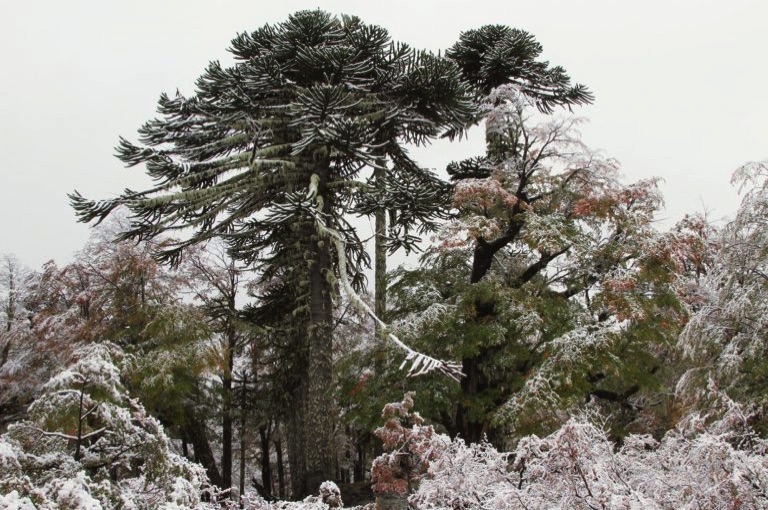
Fresh snow on araucaria trees (Araucaria araucana) with old man's beard lichen (Protousnea poeppigii), lenga trees (Nothofagus pumilio) and ñire trees (Nothofagus antarctica) in Autumn, Villarrica National Park, Chile
The parks there are generally well-managed, with good networks of trails, and there's lots to see – including beautiful lakes, snow-covered volcanoes, interesting wildlife such as the Magellanic woodpecker and brightly-coloured lizards, and of course the impressive araucaria trees themselves.

The araucaria are an ancient lineage of trees, having existed on the planet since before the time of the dinosaurs, and individual trees can live for over 1,000 years.
Covered in old man's beard lichens, and producing spherical fruits eight inches in diameter that each contain over 100 large edible seeds, the trees have real character – they have a timelessness about them that hints at their multi-million year presence on the planet.
Experiencing them close up also shows how they've obtained their common English name – the tough triangular scales that form the trees' leaves are very spiky and prickly, making them impossible to climb, either by monkeys (although none occur in the araucaria region) or any other mammals.
Southern crested caracara or traro (Caracara plancus) near Tolhuaca National Park, Chile
Young araucaria tree (Araucaria araucana) amongst ñire trees (Nothofagus antarctica) and mature araucarias in Autumn, Conguillio National Park, Chile
I had a wonderful time there during those three weeks, despite the vagaries of the weather, which alternated from torrential rain in the first week to warm sunny days. There was also an unseasonal heavy fall of snow – creating remarkably beautiful landscapes of trees with brightly-coloured autumn leaves covered in white!
In all of this, my Páramo Halcon Jacket (donated for a special event in 2012 when Trees for Life planted its one millionth tree) kept me warm and dry – I wouldn't contemplate going on a journey like this without it!
This article originally appeared on The Páramo Blog - a space for sharing thoughts and stories about Páramo Directional Clothing, nature and the outdoor life.
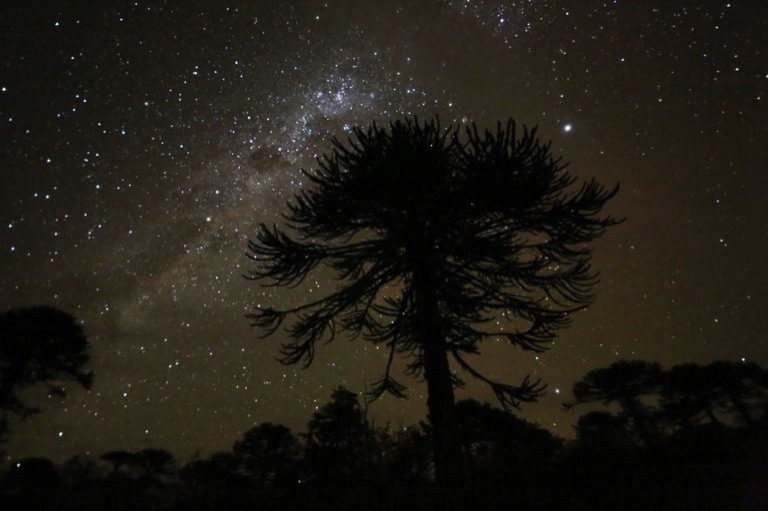
Stars in the Milky Way at night over an araucaria tree (Araucaria araucana), Conguillio National Park, Chile

Alan Watson Featherstone in his Halcon Jacket amongst araucaria trees (Araucaria araucana) covered in old man's beard lichen (Protousnea poeppigi) & ñire trees (Nothofagus antarctica) in Autumn, Conguillio National Park, Chile
Alan Watson Featherstone is an acclaimed conservationist and the Founder of Trees for Life, one of Scotland's leading conservation charities, for which he has overall responsibility. He writes a popular blog on the Trees for Life website. He has won many awards for his environmental work, including an alternative New Year's honour by The Guardian newspaper in a celebration of the heroes of 2015.

Green Adventures September 2016