
Peakland packhorses
Paths that have been used since the 10th century now form a network of walking trails in the UK's Peak District. By Jay Collier.
One of the pleasures of country walking is to come across historic features with a tale to tell. In the UK's Peak District for example, countless miles of footpaths owe their origins to packhorse trails, recorded in England as far back as the 10th century.
Between the 14th and 18th centuries a particularly widespread network was laid across the land. The volume of goods carried by a packhorse team was impressive – one breed of tough little pony, the Galloway, could carry up to 100kg apiece on an eight-hour journey.
These beasts of burden were the only means of transporting goods in and out of such difficult areas as the Peak, tackling steep hills and peaty moors inaccessible to waggons and carts.
Pack animals were laden with goods packed into wicker panniers, one slung on either side of their backs. An account of scenes at Ashford in the Water in the early to mid-19th century describes the carriage of Staffordshire crockery and stoneware on donkeys fitted with baskets fastened to a special wooden packhorse saddle. A medium-sized packhorse train might consist of 40 animals, although as many as 70 were not uncommon.
The man leading the team was known as a jagger – now more familiar as a famous surname. Two fields near Harborough Rocks above Wirksworth are named Jaggerways and the Peak has several Jagger's Lanes, a Jagger's Gate and near Edale, Jagger's Clough – part of an old packhorse way from Chapel-en-le-Frith.
Over the course of time, stretches of soft ground began to be paved with stone slabs. Where a bridge was needed, it was often just a few narrow slabs with very low parapets – if any – so as not to hinder the panniers. Many river crossings were merely fords, as at Alport near Youlgreave, on the old route from Manchester and Stockport to Derby and London.
Hops, coal and salt
In 1718 a petition for a horse bridge at Alport was presented to JPs sitting at Quarter Sessions, who were told that 'Great gangs of London carriers as well as drifts of malt-horses and other carriers and passengers, goe this ancient waye, which lies in a hollow frequently overflowed by the swollen stream. Heavy rains have so scoured out the channel as to render the ford impassable for as long as 8 to 10 days'.
Peakland winters were particularly dangerous for packmen. In the late 1600s John Webster and his six horses were caught in a snowstorm between Pike Hall and Hurdlow, their bodies not found until the spring.
Pack animals would be burdened with such necessities as brewer's malt, cloth, wool, leather, coal, salt and – especially in the Peak – lime, lead or copper ore and even stone.
Burnt lime was in great demand for agricultural use but was the most dangerous of all packhorse loads, causing severe burns if it got wet. So it was vital to prevent the lime from touching the horses.
Hops for beer were brought into the Peak as return goods by carriers taking minerals to London and the ports. Passing southwards were woollens from the West Riding and coal from South Yorkshire coalfields.
Enormous quantities of Cheshire salt went eastwards via Buxton to and on to Chesterfield, where the name Saltergate has been in use since at least the late 1200s.
The Peak has several Packhorse Farms, also Packhorse Inns at both Little Longstone and Crowdecote.
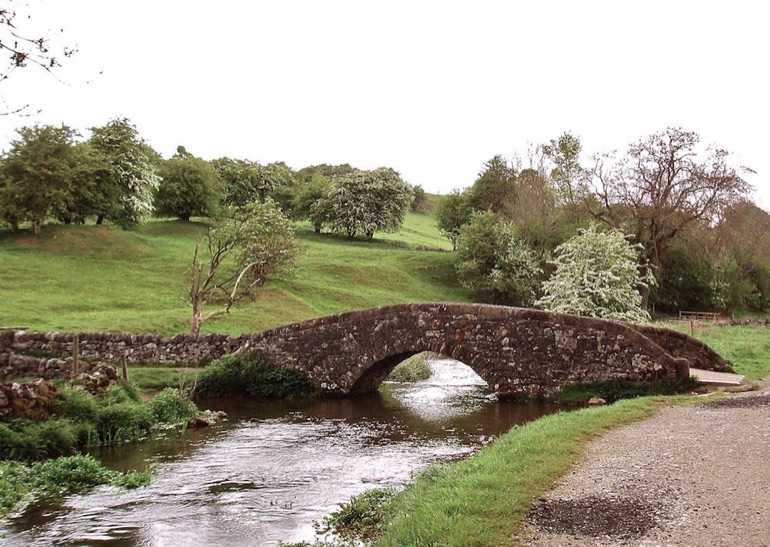
Ramblers may find themselves crossing one of the region's surviving narrow stone packhorse bridges such as Holme bridge on the Wye at Bakewell, a shorter one on the lovely river Bradford near Youlgreave, two on the famous river Dove and a mere 27-inch wide photogenic bridge on the little river Noe at Edale.
Green Adventures August 2016


Top: Bridge across the River Bradford, Youlgrave. Above and below: Holme Bridge, Bakewell